
Introduction
People usually remember to plan for moving day, booking movers and buying boxes, but they always forget to plan for their food.
Food Items Before Moving can create issues and can be costly, both monetarily and in time. Bad food management can lead to box spills, spoilage, pest infestations, and your boxes weighing more than they should. This is a no-nonsense guide to managing food ahead of time before moving day.
Why Managing Food Items Before Moving Is Important
When moving, most people must pay based on the weight of the move. Food is heavy. Moving a full pantry can add an unnoticed 40 to 80 kilograms to your load.
Food is a cause of unsanitary conditions when moving. It can spill, rot, or even attract insects. This can be especially true when first moving into a new home or apartment.
Another problem created by food is waste. Many families moving unexpectedly waste a lot of food, but it can be better organized before moving day. You can also plan to eat, donate, or pack food over a 2- or 3-week period.
Types of Food and Handling Each Category
There are many types of food. Each kind needs to be handled differently. Knowing what you are dealing with first is important.
Perishable Foods
These are foods that go bad after a certain period. These foods are fresh fruits and vegetables, meat, and cooked. These foods will always go bad and must be eaten or thrown out. Therefore, perishables should not be moved or transported especially on big moves.
Rule: Perishable foods should be eaten at least two weeks before moving day. Fresh foods should be stopped a week before moving day. Refrigerated perishables should never be moved on a trip that is longer than a few hours.
Non-Perishable Foods
Some foods move well. These foods are not meant to go bad after a certain period. These foods are dry grains, flour, pasta, and, of course, foods that are sealed. These foods go great in a moving box, but should be thrown out if they perish.
Rule: Always check foods. Foods must not be expired and must be edible. Look out for dents, cracks, and seals that are broken.
Frozen Foods
These types of food are not meant to be transported. Frozen foods must be moved in sub-zero and ice-packed vehicles.
Rule: start moving in two weeks. Eat what you can. Throw out sealed frozen food that will not be consumed during the move. Start fresh at the new place.
How to Organize Food Before Moving
For best results, complete this checklist four weeks before your move:
- Week 4: Have a complete kitchen audit. List everything in your pantry, fridge, and freezer, and go item by item.
- Week 3: Build meals based on pantry stock. Eliminate unnecessary grocery purchases. Focus on perishables and frozen stock, and something in the freezer.
- Week 2: Sort your pantry. Create four categories: consume, donate, pack, and discard.
- Week 1: Stop stocking. Clear the fridge. Ensure your ‘pack’ category is sealed, labelled, and ready.
- Moving Day: You should only have sealed, non-perishable items.
What to Eat, Donate, Pack, or Throw Away
You have to make a lot of decisions regarding food. Here is the general framework to simplify your packing.
Eat: Fresh produce, dairy, leftovers, open packets, and anything perishable. You should use this up as much as possible. This also includes anything in your pantry you should doubtlessly use.
Donate: Unopened and unexpired canned goods, sealed, and in good condition packaged food, surplus dry goods you do not plan to use. If the food is good, contact a local food bank or Community Kitchen. Many organizations can accept you to divvy up bulk drop kitchen donations.
Pack: Non-perishable leftovers.
It is time to discard expired products, open containers, anything with a compromised seal, half-used spice jars, and mystery items from the back of the shelf. Be ruthless. Discard items that have not been used in the most recent six months. You likely won’t use it in your new home.
How to Safely Pack Non-Perishable Items for Moving
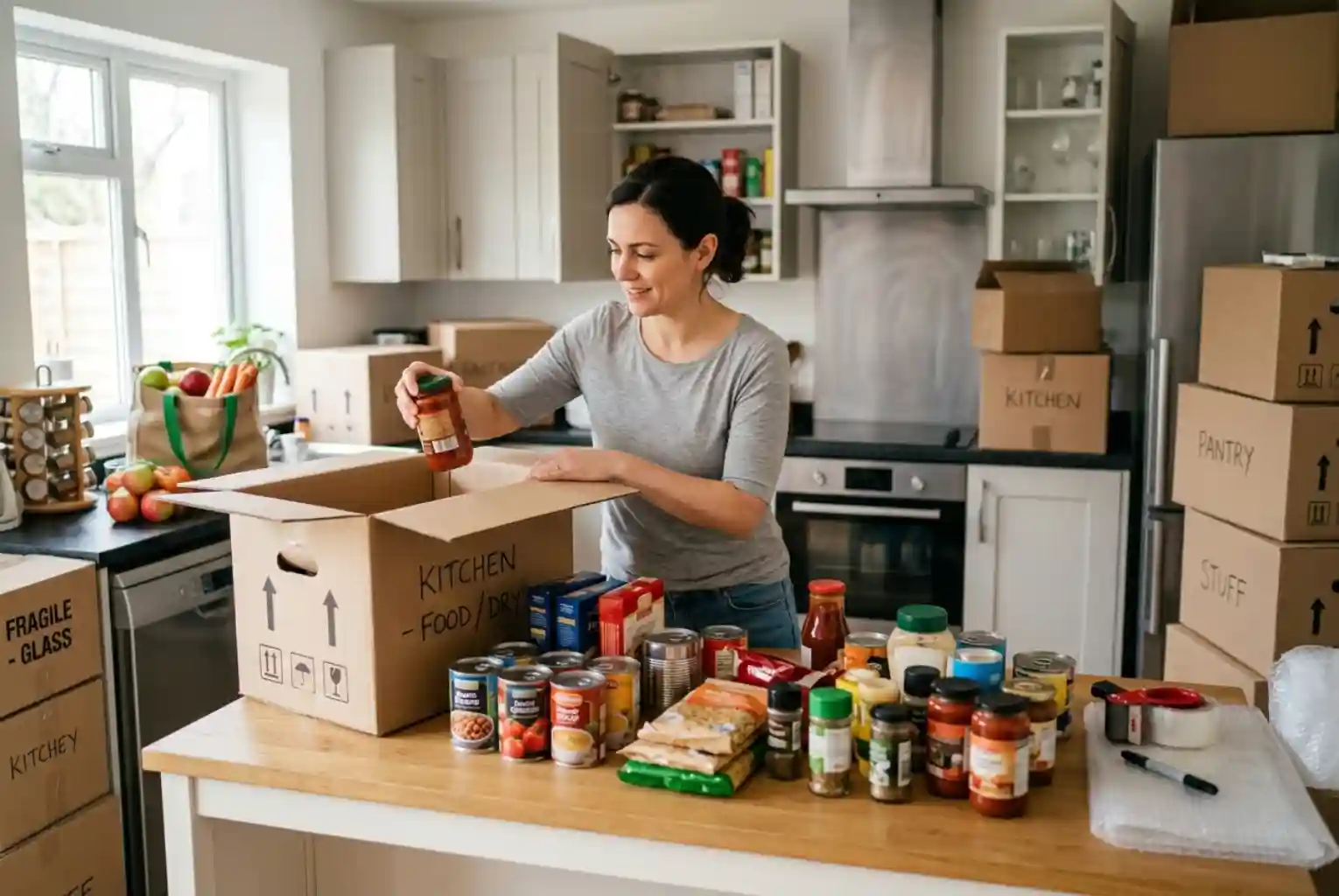
When it comes to packing food for a move, we want to achieve no leakage, no contamination, and still keep the weight manageable. Follow these guidelines:
- opt for smaller boxes. Larger boxes may become too heavy when filled with cans and risk them breaking. Try to keep food boxes to a maximum of 15 kilograms.
- Be sure to tape every lid and seal. You’ll be surprised to find that factory-sealed items open under pressure or due to their positioning. Use packing tape to secure acrylic lids.
- Individually wrap jars using bubble wrap or packing paper. A single glass jar will break multiple jars.
- Keep all containers sealed and in their original packaging. Original packaging will carry all important information, such as expiration dates.
- Be sure to properly label all of your boxes. Specify ‘Kitchen- Food’ for food items, include info about fragility, and anything else that will be helpful in the organization of your items.
- Lastly, keep food items separate. Cleaning supplies, toiletries, and anything not food-related items should not be in the food boxes for the sake of contamination risk.
What Should Not Be Included in Your Moving Boxes
It is better to avoid packing anything that is potentially hazardous or would require too much time or effort to pack.
Avoid packing:
- Open containers, be it sauce, oil, vinegar, or grains
- Liquids in glass bottles (unopened bottles don’t leak, but they are still a risk)
- Alcohol (some moving companies could restrict it or it could break)
- Preservation methods (pickles) that are unrefrigerated and do not have a proper label
- Spices sealed in a paper packet (the pack can break and the spice can spill)
- Anything that is not durable and has a shelf life of less than three months
If you are not sure whether to pack it, do not. Dealing with the Odor of a ruined jar of spices is not worth it.
What Not to Do When Moving Food
What these professionals relocate have far too frequently witnessed these mistakes:
Not starting soon enough. You should allow at least four weeks for a thorough food evaluation. One week gives ness time to plan, eat, or donate.
Packing too much. Do not pack an excessive amount of food. Your food shouldn’t be wasted, but it also shouldn’t cost you, and because of poor planning, it will eventually be wasted.
Forgetting the freezer. One of the most common mistakes is leaving food in the freezer. Defrosting it is difficult and time-consuming. Most people don’t plan for it.
Liquid packing negligence. Items like oil, soy sauce, and vinegar are all time bombs for leaking, ruining documents, clothes, and electronics in the same shipment.
Food box entropy. These boxes are poorly labelled and take forever to unpack. They are also prone to being crushed by the weight of the boxes stacked above.
Food storage tips and tricks to save money
The following are good practices for dealing with food items during a move:
- For the last three weeks, create meals using whatever is in stock.
- Invite friends over to eat any food that is left in your house. Less food is good, and it serves as a goodbye.
- Plan to donate food 2 weeks out and then donate again before the big day. Food banks like to organize the donations, so it is helpful to let them know in advance.
- When you start to clean out your pantry, take a picture so you can refer back to it instead of checking all the time to see what you have left.
- When moving, if you think something may not need to be packed, you can replace it cheap, then don’t pack it.
- The day before you move, do one last clean-up of the fridge. Throw everything left out and clean the fridge. Then leave the door open and unplug it.
Conclusion
Managing your food items before moving is one of the most overlooked parts of relocation planning, though it is often overlooked. It can impact how much you pay to move, how your items are organized when you move, and how easily you settle in at your new place.
There is a clear way to tackle this problem. It includes auditing food items, eating food items, donating food item, packing food items, and throwing food items away. Time deteriorates food and makes your moving day complicated and your moving day load heavier.
Start your kitchen audit now. It will reduce your waste, save you money, and give you one less thing to manage in addition to the hundred other things you are managing.

