
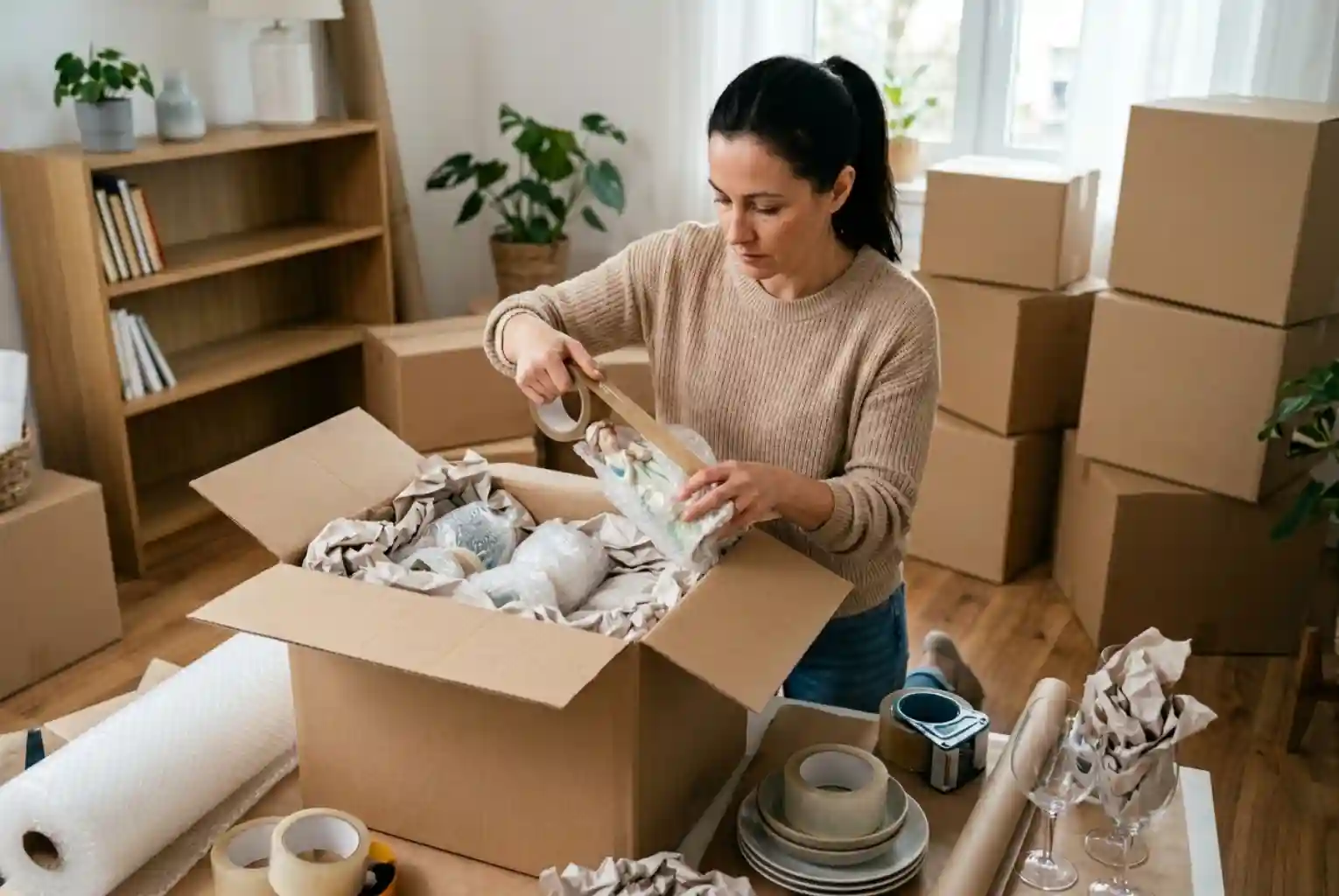
Introduction
Look at the stats. Millions of moves are completed every year. Most glassware, ceramic, and electronic belongings are broken during moves. Why? Poor packing. Safeguarding your belongings during a move is not optional. Items can break, and it can be your fault. Learn how to Pack Fragile Items Safely. Use this detailed guide to pack your items before and after your move.
Why Your Fragile Items Need Extra Level Packing
Moving boxes are not built to move infinitely. They are not designed to take a multitude of the same impacts again. They are not designed to survive a move. Moving boxes can and will move your belongings. They will take sharp impacts from walls and instruments throughout the move. If a box is poorly built and poorly designed, it can not only ruin your belongings, but it can also ruin your life. Seriously, for the sake of your mental health, you do not want to replace your sentimental items. You also do not want to start an insurance claim at the worst time, during a move. Damage repairs also suck. They will literally add an hour to your move. That’s how infuriating repacking is. You add extra labour for the movers, and you’re required to pay for damaged items. Investing in high-quality moving boxes pays for itself.
Types of Fragile Items and How to Pack Them
What’s your most delicate item? Getting glass and ceramics are relatively equally vulnerable. They both can break from the same impact and force. These items also need the same protection. Individual wrapping is required for all. They also need supreme cushioning and insulating the box. Items need to be secured vertically and are not allowed to be boxed or shared with other moving items, like heavy boxes.
- Electronics: All electronics are created by manufacturers, preserving the safety of the product inside the box. If the box is not available, electronics need to be protected by anti-static foam.
- Artwork and Framed Items: All artwork and framing are susceptible to moisture and impact. Framed artwork during transit must be protected by moisture resistant glassine and corner protectors. Framed artwork may also need a custom crate.
- Mirrors and Large Glass Panels: Mirrors and glass panels need to be transported vertically and should not be transported flat. Glass panels and mirrors require padding and surface protection. Padding should include an X pattern along the surface of the glass. These also need to be transported with edge padding.
- Musical Instruments and Collectibles: Musical instruments and collectibles are irregularly shaped, high value collectibles. For this reason, musical instruments should have a hard case and be secured with padding.
Checklist of Packing Materials Required
Using correct materials improperly only adds and increases damage. For example, old newspaper and a thin plastic film are poor materials. Old newspaper stains with ink and thin plastic provide no protection. For the following materials, be prepared before packing.
- Corrugated double-walled boxes with larger dimensions
- Different dimensions for bubble wrap, large and small
- Unprinted, clean newsprint packing paper
- Foam sheets and foam peanuts
- Acid and free tissue paper for collecting and protecting artwork
- Heavy duty packing tape, minimum, 2 inches
- Mark your boxes
- Cell dividers and specialty dish boxes for glassware
- Corner protectors for mirrors and frames
- Anti-static bags
Household materials should not be substituted for professional packing supplies. For example, towels and newspapers provide only varied protection. Towels may shift, and newspapers may ink.
Pack Fragile Items Like A Pro
- You can use this process for every one of your fragile items.
- First, prep your box. Put in your packing crumpled paper or foam peanuts and add 3 to 4 inches to your bottom layer. This will absorb the impact.
- Never place two items that haven’t been wrapped together. Wrap all your items and make sure to use the paper to cover all edges and surfaces.
- Place your heavier items at the bottom. Don’t reverse this order.
- You should add crumpled paper or foam peanuts to all empty spaces. A box that has empty spaces can cause items to shift or collide.
- Test the rocking box before closing the box to see if there are any further adjustments that need to be made. A box should never give a sound when closed.
- Tape your box well. Use the H-taping method. Tape along all seams on the top and bottom. Do not use one medium piece of tape at the center. Use tape that is good for heavy items.
Packing Glass, Electronics and Other Fragile Items.
Packing Glassware
Packing paper and glass cell boxes should be used. Place dividers for each glass or cup. Each glass should be wrapped in two full sheets of packing paper. Glasses should be stored upright. Bowls nest with packing paper. Vertical storage for plates.
Packing Electronics
All cables should be taped to the outside device and wrapped in zip-lock bags. Screens should be wrapped in anti-static foam, or bubble wrap should be used, with the bubble side outward. The original box should be used for televisions. If original boxes are not available, use corner protectors on the screen and double-walled boxes. Mark the box “screen side up” and “do not stack”.
Packing Mirrors and Artwork
For safety, use masking tape and make an X in the middle of the glass. This will cause minimal shattering. For glassine paper and bubble wrap should be used. Use guards for the ends of the bubble wrap. Pack frames in sets and boxes or mirrors. Do not place artwork in general boxes.
Common Errors When Packing Fragile Items
Overpacking is perhaps the most harmful/successfully destructive thing that one could do.
Overpacking boxes. The more items packed into one box, the better the use of space. Items are packed on top of one another, which increases the risk of the box failing and items at the bottom becoming damaged.
Individual Wrapping is Essential: You assume that two ceramic mugs touching each other is fine. Although they are touching each other, they are unwrapped, and therefore vulnerable. Everything needs to be wrapped.
Using Appropriate Box Sizes: Make sure you are using the right box size. Everything relies on the right size box to keep pressure off the items throughout the entire moving process.
Stop Leaving Empty Spaces!: Empty spaces are like a box without a destination. Once the box is moved, the contents will shift and move, and that leaves the items vulnerable for damage.
Be Aware of What You are Box Stacking. This is the most basic moving principle. If you are using the boxes as storage, use your bottom boxes to support your lighter and more fragile items.
The right boxes are New ones: A boxes duty is to be protective and supportive. Once a box has been used, its structural integrity is compromised.
How to Label and Handle Fragile Boxes Correctly
How to Handle Fragile Boxes is that when you box your valuables, be sure to label each box carefully, as this ensures they are treated more delicately than other boxes.
Make sure that other boxes aren’t in the immediate area that may compromise the fragile box. Use a market with a wider tip and with bright colored markers to note the box as Fragile on all 4 sides and on the top. If the box is heavier, in addition to the marking tip, be sure to install placards on the side that say `THIS SIDE UP`. Once the box is in its new spot, please make sure it is a new addition by leaving a note on it with the name of the new room.
When moving and loading boxes, talk about which boxes are fragile. The label of the box is not enough, and in an environment with a lot of boxes, it is even more crucial.
How to Safely Move and Unload Your Boxes
How you pack your boxes to begin with is only half the battle. How you load the boxes and transport them is an entirely different story. Here are a few safe transport and unpacking tips.
- Load boxes that contain fragile items last so they will be the first to be unloaded. This is to make sure they do not get buried beneath heavy items.
- Keep fragile boxes stored against the walls of the vehicle. This is to control movement and limit the boxes from sliding around.
- Never place boxes consisting of fragile items underneath boxes of heavy appliances or furniture, regardless of how well that box is packed.
- Placing non-slip matting underneath the box marked fragile can also help control movement and sliding.
- When unloading, fragile boxes should be transported separately. It saves time to take several boxes at once, but not with fragile items.
- Finally, once you get to your destination, make sure the boxes marked fragile are the first to be opened. There might be damage you didn’t get to see before, so make sure to take pictures of the damage when you see it and throw the packing materials away.
Conclusion
Being able to pack fragile items safely and still keep them intact is not due to extra careful movers or luck. It comes down to using the proper materials, being consistent with the wrapping, packing, placing handling instruction labels on the boxes, and being careful with where you position them in the vehicles.
Every part to this guide is the result of making a mistake when moving and damaging a treasured possession. There are no shortcuts to using these techniques, and you should expect that your fragile items will keep the same condition they left in when you follow them.

